What We Learned About Robots at Our First Virtual Family Science Night

A robot is not just a shiny machine from a movie. It is a tool scientists use to test new materials, explore distant planets, support doctors, and answer questions that would be too slow, too dangerous, or too small for humans to handle alone.
Recently homeschool families from across our community logged on for the first session of our free monthly virtual STEAM series. The session was presented in partnership with Bridge the Gap Robotics Foundation, a student-led STEM nonprofit that shares robotics learning with young people and families.
Catch the Video Recap Below
Together, we explored one big question:
How do robots help scientists do real work?
The answer took us from robot-run labs to Mars rovers, from surgical tools to tiny nanobots. It also led to thoughtful questions from students about trust, safety, and what can happen when a robot makes the wrong move.
We started by asking what makes a robot a robot
The session began with a simple definition:
A robot is a machine controlled by a computer that can sense its environment, make decisions, and take physical action.
That definition helped separate robots from other tools.
A toaster may be electric, but it is not usually a robot. A remote-control car moves, but it may not sense much or make decisions on its own. A Mars rover, by contrast, can use sensors to study its surroundings, follow instructions from a computer, and move across the surface of another planet.
Most robots include a few basic parts:
Sensors
These help the robot gather information. A sensor might detect light, distance, temperature, pressure, sound, or motion.
A computer or controller
This is the “thinking” part. It processes information and follows instructions.
Actuators or moving parts
These let the robot do something physical, such as roll forward, grip an object, turn a wheel, or move an arm.
Power
Robots need energy. Some use batteries, some plug in, and some are designed to work with solar power or other sources.
This definition also gave families a useful way to look at robots in the real world. Instead of asking, “Does it look like a robot?” students learned to ask better questions:
Does it sense something?
Does it process information?
Does it take action?
Can it repeat a task or respond to changes?
Those questions came up again and again as we moved through the science examples.
Robots are changing how scientists discover new materials
The first science stop was materials science, the study of what things are made of and how those materials behave.
Materials science affects everyday life in more ways than most people realize. The glass on a phone screen, the metal in a bicycle frame, the plastic in a medical device, the battery in an electric car, and the heat shield on a spacecraft all depend on materials research.
Scientists have predicted hundreds of thousands of possible new materials. Some could help make stronger batteries. Others might support cleaner energy, better electronics, or safer construction. The challenge is that predicting a material is not the same as making it.
A scientist still has to ask:
What ingredients are needed?
What temperature should be used?
How long should the material be heated?
What happens if the recipe changes slightly?
Did the final material actually form?
Testing those questions one sample at a time can take a long time. That is where robots can help.
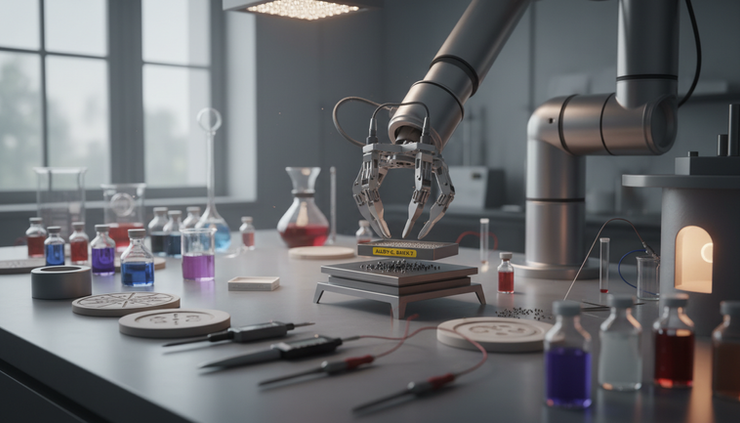
During the session, families learned about Berkeley Lab’s A-Lab, a robot-run lab guided by artificial intelligence. The A-Lab can prepare and test many more samples in a day than a person working by hand. The session noted that it can process 50 to 100 times as many samples as a human in a day.
That number gave students a clear picture of why scientists use robots for this type of work. A robot does not get bored by repeating careful steps. It can measure, mix, heat, cool, and test again and again. That makes it useful for searching through many possible material recipes.
When a robot can run careful tests over and over, scientists can spend more time asking better questions and less time repeating the same motion by hand.
This part of the night also showed why robotics belongs in STEAM, not just STEM. Designing a lab robot takes science, technology, engineering, and math, but it also takes creative problem-solving. The robot has to fit the task. It has to move safely. It has to handle materials in a controlled way. It has to be designed for real people to use, maintain, and understand.
Robots go where humans cannot safely go yet
Next, the session traveled beyond Earth.
Space is one of the clearest examples of why robots matter. Sending humans into space takes enormous planning, protection, and resources. Some places are too far away, too cold, too hot, too dusty, or too dangerous for people to visit right now.
Robots give scientists a way to explore anyway.
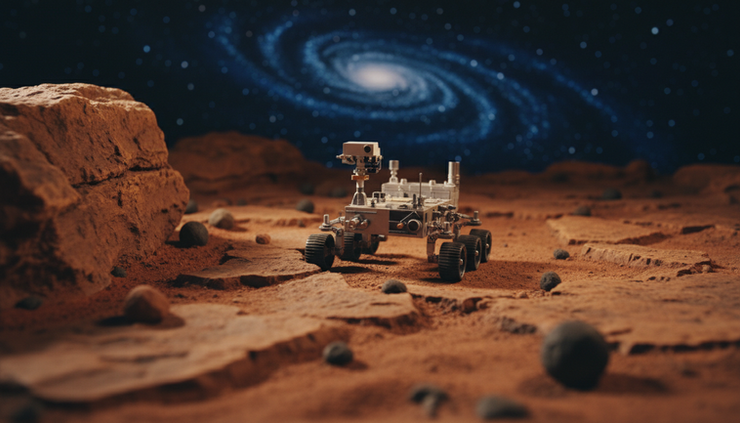
Families talked about Mars rovers, which move across the Martian surface and study rocks, soil, weather, and signs of past environments. A rover needs to survive harsh conditions, process instructions, avoid hazards, and send information back to Earth.
We also discussed the Voyager probes, famous robotic explorers that have traveled farther from Earth than any human-made objects before them. They remind students that robots do not need arms, faces, or wheels to count as robots. A spacecraft can be a robot if it uses instruments, follows computer instructions, and gathers data.
The session also introduced several space science examples:
NASA testing Mars heat shields with jet arcs
The FUTABA flight model from Space Station research
Robots that study comets and asteroids
Spacecraft designed to collect data in places humans cannot visit directly
For students, space robots often make the idea of engineering feel real. A rover cannot stop by a repair shop on Mars. A probe cannot ask someone to tighten a screw after launch. Every part has to be planned, tested, and built with care.
That led to a helpful discussion about failure. What happens if a wheel gets stuck? What if dust covers a solar panel? What if a sensor sends confusing data? Engineers have to imagine many possible problems before a robot ever leaves Earth.
They also have to design robots that can work with delays. A command sent to Mars does not arrive instantly. That means a rover may need some ability to make simple decisions without waiting for a person to guide every inch of movement.
This is one reason space robotics is such a strong teaching example. It blends imagination with strict limits. Students can dream about exploring a moon or asteroid, but they also have to think about weight, energy, distance, temperature, communication, and risk.
Robots in health science raised the biggest questions
The health science part of the session showed another side of robotics. Here, robots are not exploring space or testing materials. They are working close to people.
Families looked at examples such as:
Surgical robots
UV disinfection robots
Robotic prosthetics
Tiny nanobots being studied for possible medical uses
This section sparked some of the most thoughtful student discussion because health robots can feel both helpful and risky.
A surgical robot, for example, does not replace the need for trained medical professionals. These systems are tools that can help with precise movements during certain procedures. The human medical team remains responsible for planning, decision-making, and patient care.
UV disinfection robots offer another example. Hospitals and other facilities may use ultraviolet light to help disinfect certain spaces or surfaces. A robot can move through an area and follow a set process. Still, people have to make sure the robot is used safely, since UV light can be harmful with direct exposure.
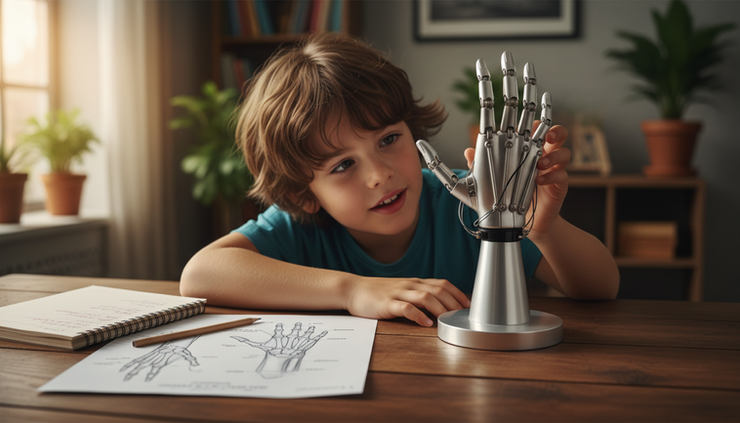
Robotic prosthetics helped students see how robotics can support movement and independence. A modern prosthetic may include sensors, motors, and software that respond to how a person moves. That makes the connection between human biology and engineering easier to understand.
Then came nanobots, one of the smallest and most imagination-stretching ideas of the night. Students learned that scientists are studying tiny machines and microscopic tools that may one day help in medical research and treatment. This field is complex and still developing, which made it a good chance to talk about the difference between current real-world tools and future possibilities.
Because this part touched on health science, the discussion stayed careful and educational. The goal was not to give medical advice. It was to explore how engineers, doctors, researchers, and computer scientists work together to design tools that may help solve difficult problems.
The kids also took on a big question:
What might go wrong?
That question matters in every part of robotics, but it feels especially important in health science. Students named possible concerns, including:
A sensor might read something incorrectly.
A machine might move in an unexpected way.
A person might trust the robot too much.
A robot might work well in one setting but not another.
A design might not fit the needs of every user.
Those are not reasons to avoid robotics. They are reasons to design carefully. Good engineering includes testing, feedback, safety rules, and honest conversations about limits.
We compared robots and AI without mixing them up
One of the most useful parts of the night was the difference between robots and artificial intelligence.
The two often appear together, but they are not the same thing.
A robot is a physical machine. It has parts that can interact with the physical world. It may roll, lift, sense, grab, cut, clean, fly, or measure.
AI is software. It learns from data, finds patterns, makes predictions, or helps make decisions.
A robot can exist without AI. For example, a simple factory robot may repeat the same programmed movement again and again. It does not need to “learn” in order to do its job.
AI can also exist without a robot. A program that recommends a movie, recognizes speech, or sorts images is using software, but it does not have a physical body.
The most powerful science tools often use both. A robot-run lab may use robotic arms to handle samples and AI to suggest what experiment to try next. A rover may use physical wheels and cameras, plus software that helps it identify safe paths. A robotic prosthetic may use sensors and code to respond to the person using it.
This comparison helped students avoid a common mix-up. If something “thinks” but does not move in the physical world, it may be AI but not a robot. If something moves but only follows a simple set of instructions, it may be a robot but not AI.
The key is to ask what the system actually does.
The activity sheet keeps the learning going at home
Family Science Night did not end when the call ended. Students can keep learning with the free Robots in STEAM Activity Sheet.
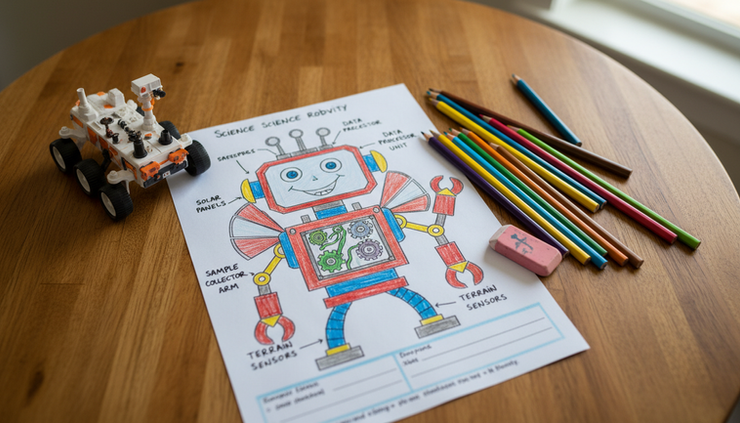
Get the activity sheet here. It invites kids to review what they learned, research a real-world robot, and design one of their own. Suggested examples include:
Astrobee
A free-flying robot used on the International Space Station to help with research and routine tasks.
PARO
A robotic baby seal designed for therapeutic use in some care settings.
Artemis I Orion
The spacecraft from NASA’s Artemis I mission, an example that can help students think about spacecraft systems, sensors, and automation.
After researching a real robot, students can sketch and label their own design. This is where the “A” in STEAM shines. Drawing a robot is not just decoration. It helps students explain what their robot is supposed to do.
A strong robot design should answer questions like:
What problem does the robot solve?
What sensors does it need?
How does it move?
What physical action can it take?
Who will use it?
What could go wrong?
How could the design be made safer?
This kind of activity turns a science topic into a design challenge. Students are not only repeating facts. They are making choices, explaining reasons, and imagining trade-offs.
Families can also share student creations with @homeschoolsteamfest so the learning continues across the community.
What this first Family Science Night taught us
Our first virtual Family Science Night showed that robotics is a powerful way to connect many parts of STEAM.
Robots helped us talk about chemistry, engineering, space science, computer science, health, ethics, design, and creativity in one evening. They also gave students permission to ask practical questions:
How does it work?
Who controls it?
What data does it use?
What happens if it fails?
How could we make it better?
Those questions are at the heart of good science learning.
A big thank-you goes to Bridge the Gap Robotics Foundation for sharing their passion for robotics with our families. Their student-led approach made the topic feel welcoming, current, and aproachable.
Next month, our free virtual STEAM session will explore another theme connected to what STEAMventure Learning Labs students cover in class. The whole family is welcome, whether enrolled or not.
Robots may seem complex at first, but the best place to start is simple: notice what a robot senses, how it decides, and what action it takes. From there, students can begin to see robots not as magic, but as tools people design to solve real problems.
Robot on!
Comments